Stinging insect activity in central Gwinnett County accelerates between April and October as queens initiate colonies under architectural shelter. In communities like River Oak Village, Chandler Woods, and Castlegate,…
Stinging insect activity in central Gwinnett County accelerates between April and October as queens initiate colonies under architectural shelter. In communities like River Oak Village, Chandler Woods, and Castlegate, European hornets and aerial yellowjackets construct papier-mâché nests in open soffits, gable vents, and covered porch ceilings. Properties bordering dense tree cover near Freeman's Mill Park or Alexander Park experience persistent paper wasp nests suspended inside deck railings and outdoor storage sheds. Mud daubers gather red clay along exterior mortar joints in Freeman Crossing and Abington Green, leaving rigid dirt tubes that attract secondary beetle activity if left unsealed.
Effective management relies on species-specific intervention rather than indiscriminate broad-spectrum broadcast spraying. Paper wasps construct open-cell hexagonal combs requiring direct knockdown and nest scrapings, whereas yellowjackets often build enclosed nests subterraneanly in abandoned rodent burrows or within drywall voids after breaching uncaulked siding. If yellowjackets nest within an interior wall void in Woodhaven or Bramlett Forest, treating the exit hole without specialized dust formulations risks driving thousands of defensive insects into living spaces. Technicians isolate structural access points, apply directed non-residual botanical desiccant dusts directly into the gallery, and seal the entry void with copper mesh.
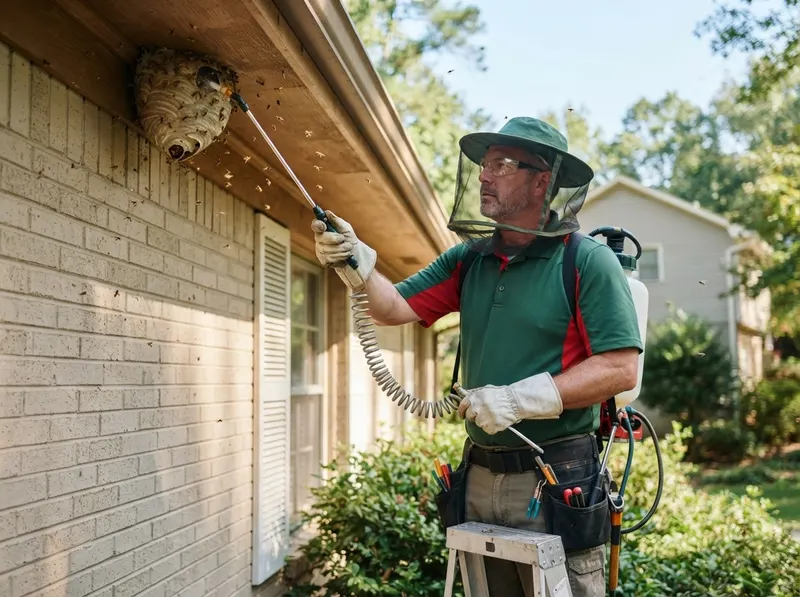
Homeowners managing active colonies face a clear operational trade-off: over-the-counter pressurized sprays offer immediate short-range knockdowns from ground level, but fail to eliminate unseen secondary queens or destroy structural void pockets. Professional removal pairs precision pressurized micro-injector equipment reaching elevations above 25 feet with focused structural exclusion. The process follows three distinct steps: 1. Technicians identify flight trajectories and colony entrance points across the foundation and eaves. 2. Stinging castes are neutralized using targeted contact treatments during late afternoon when foraging adults return. 3. The structural nest is mechanically removed, and the substrate is scrubbed to eliminate residual nesting pheromones that attract future spring queens. This method protects indoor pets and children from chemical exposure while stopping recurrent seasonal colonization.
Every job gets a firm, written price after a free on-site visit.
Tell us about your wasp and hornet control job in Lawrenceville and we'll send a clear, written quote, usually the same day.
 Peachwood Pest Control