Subterranean termites require continuous contact with ground moisture to survive, building mud tubes across foundation footings to bridge the gap between soil and framing timbers. In Gwinnett County neighborhoods such…
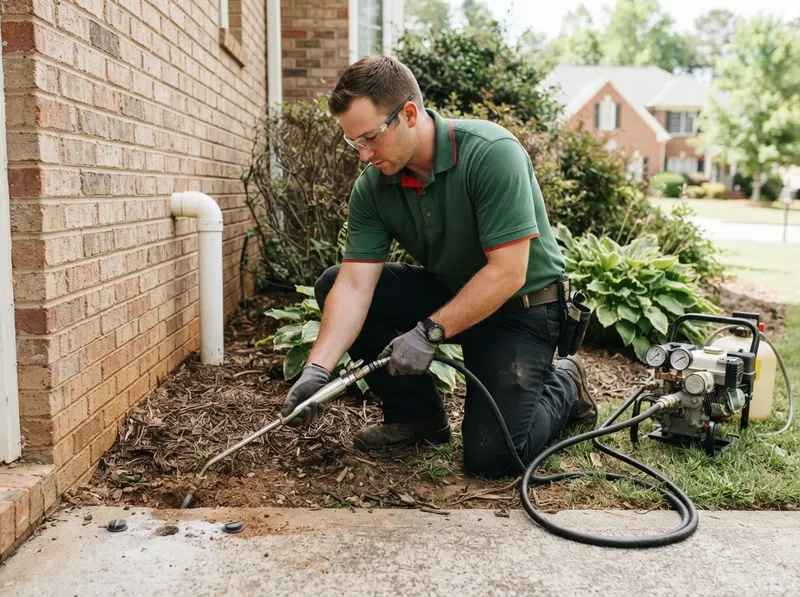
Subterranean termites require continuous contact with ground moisture to survive, building mud tubes across foundation footings to bridge the gap between soil and framing timbers. In Gwinnett County neighborhoods such as Chandler Woods, Bramlett Forest, and Woodhaven, properties built on sloping grading or near Pew Creek face steady subterranean termite pressure due to prolonged soil dampness. Georgia red clay binds liquid termiticides tightly, requiring high-pressure rod injection and trenching directly along crawlspace piers, slab joints, and basement stem walls. Non-repellent liquid treatments bypass termite detection, enabling workers to transfer the active agent throughout the subterranean colony until the queen and royal pair are completely neutralized.
Selecting between a liquid perimeter trench and an exterior bait station array depends on foundation layout and structural drainage. For monolithic slab houses in Castlegate and River Oak Village, continuous liquid trenching applies termiticide at 4 gallons per 10 linear feet, establishing immediate protection across entry fractures. Properties in Huntington and Freeman Crossing built with walk-out basements or finished flagstone patios often pair spot liquid applications at expansion joints with cellulose bait cartridges placed every 10 to 15 feet around the yard perimeter. The practical trade-off centers on intervention speed versus hardscape alteration: liquid barriers deliver immediate structural containment but require temporary soil disruption, whereas monitoring bait systems avoid drilling masonry but require 60 to 90 days of consistent feeding to register colony-wide suppression.
Subterranean termite treatment differs substantially from drywood fumigation or carpenter ant perimeter dusting. Eastern subterranean termites live beneath the frost line rather than within dry attic timbers, meaning wood-surface spray applications leave the primary reproductive nest intact. Treatment follows a systematic four-step sequence. First, a technician maps the building footprint, probing sill plates, rim joists, and hollow-block masonry foundations. Second, technicians dig a 6-inch trench along structural perimeters and drill vertical access holes through adjacent outdoor slabs at 12-inch intervals. Third, liquid termiticide saturates the trench backfill, creating an unbroken treated band. Fourth, technicians secure discrete tamper-resistant soil stations in vulnerable garden beds to catch auxiliary foraging paths before termites reach structural sills.
Every job gets a firm, written price after a free on-site visit.
Tell us about your subterranean termite treatment job in Lawrenceville and we'll send a clear, written quote, usually the same day.
 Peachwood Pest Control